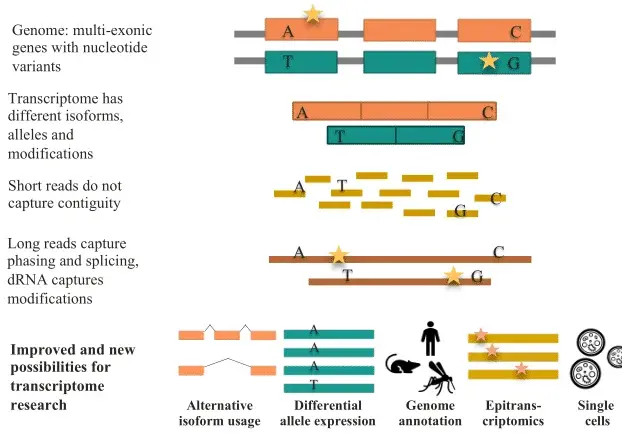
Over the past decade, third-generation sequencing (TGS) technologies, mainly Oxford Nanopore and Pacific Biosciences, have transformed genomics by enabling single-molecule sequencing and producing ultra-long reads spanning tens of thousands of nucleotides. These features overcome limitations of short-read platforms, allowing long-range phasing and direct detection of epigenetic modifications such as DNA methylation. In transcriptomics, long-read RNA sequencing (lrRNA-seq) provides full-length transcript information, improving the identification of isoforms, alleles, and gene family members, while Nanopore’s direct RNA sequencing further enables the study of RNA modifications, opening new perspectives in epitranscriptomics. LRS has already driven major milestones, including the telomere-to-telomere assembly of the human genome and the advancement of large-scale biodiversity initiatives. While the technology has largely replaced short reads in genome assembly, challenges remain in library preparation, mapping, and transcript quantification. Nevertheless, lrRNA-seq is expected to become the leading approach for transcriptome profiling, with growing potential in single-cell and allele-specific expression studies.